Call us: +(20) 2 22401140 - email Us: info@pharaohes.org


If you have been following our blog – from why Egyptian HDF flooring outperforms imported options to the complete guide on PVC roofing – you already know that Pharaohes Company has been Egypt’s trusted name in high‑quality building materials since 2001. Today, we are focusing on a roofing solution that combines timeless beauty with extreme durability: clay roof tiles.
Clay tiles have been protecting homes in the Mediterranean and the Middle East for centuries. In Egypt, they are making a strong comeback – and for good reason. They withstand our intense summer heat, shed occasional winter rain, and add a classic, elegant appearance to any villa, compound, or traditional home.
In this comprehensive guide, we will cover:
- Why clay tiles are perfect for Egyptian homes
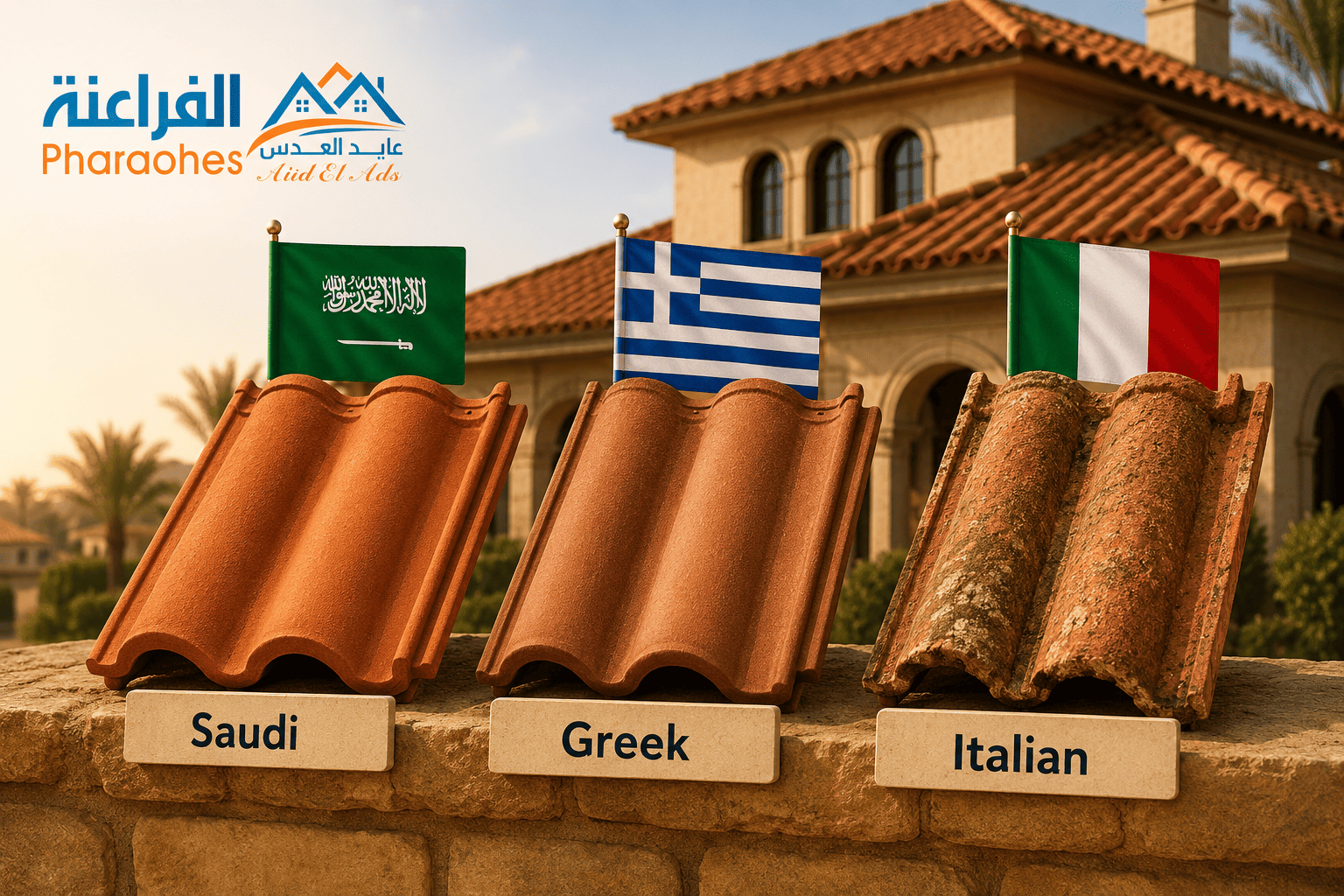
- The different types of clay tiles available at Pharaohes: Saudi, Greek, and Italian
- A detailed comparison table (characteristics, durability, price, appearance)
- How to calculate the number of tiles you need (step by step, with formulas)
- How to install clay roof tiles (complete step‑by‑step installation guide)
- Why Pharaohes is your best partner for clay roofing in Egypt
Why Choose Clay Roof Tiles for Your Egyptian Home?
Before we dive into the specific types, let’s understand why clay tiles are an excellent choice for Egypt’s climate:
- Heat resistance: Clay is a natural insulator. It absorbs heat slowly and releases it gradually, keeping your home cooler during the day. Unlike metal roofs that can radiate heat downwards, clay creates a natural thermal barrier.
- Durability: A high‑quality clay tile roof can last 50 years or more – often exceeding 100 years with proper maintenance. This makes clay one of the longest‑lasting roofing materials available.
- Weather resistance: Clay tiles are fully waterproof, resistant to frost, and can withstand high winds. They are perfect for Egypt’s occasional heavy rains and cool winter nights.
- Fire resistance: Clay is non‑combustible. In areas where wildfires or electrical faults could be a concern, clay roofs provide an extra layer of safety.
- Aesthetic appeal: Clay tiles come in warm, earthy colours (terracotta, red, brown, grey, and more) and various profiles (Roman, Marseille, Gothic, flat). They add significant curb appeal and property value.
- Low maintenance: Once installed, clay tiles require very little upkeep – occasional inspections, cleaning of gutters, and replacement of a broken tile here and there.
For these reasons, clay tiles are the preferred roofing choice for many villa compounds, tourist resorts, and high‑end residential projects across Egypt.
Types of Clay Roof Tiles at Pharaohes – Saudi, Greek & Italian
At Pharaohes Company, we offer a curated selection of clay roof tiles from three renowned origins: Saudi, Greek, and Italian. Each has its own characteristics, advantages, and typical applications. Below, we explain each type in detail.
Saudi Clay Tiles
Saudi Arabia has a well‑established clay tile manufacturing industry, with factories operating for decades. Saudi clay tiles are known for their affordability and availability, making them a popular choice for large‑scale residential projects and budget‑conscious homeowners.
Key characteristics:
- Material: High‑quality natural clay, fired at high temperatures.
- Profiles: Often available in Roman, Spanish, and flat profiles.
- Colors: Terracotta, red, brown, and grey.
- Durability: 40–50 years with proper installation.
- Price range: Medium – generally more affordable than European imports.
Why choose Saudi tiles?
- Lower cost compared to Greek or Italian options.
- Readily available in large quantities, making them ideal for contractors working on housing projects or multiple villas.
- Still offers excellent durability and aesthetic appeal.
Best for: Budget‑conscious homeowners, large residential projects, rental properties, and modern villa compounds.
Greek Clay Tiles (KEBE)
Greece has a long tradition of clay tile production, and KEBE S.A. is one of the most respected manufacturers in Europe. Founded in 1925, KEBE has over 80 years of experience in heavy clay building materials and exports to more than 25 countries, including Egypt. Pharaohes is proud to partner with KEBE to bring their premium roof tiles to the Egyptian market.
Key characteristics:
- Material: Premium natural clay, using advanced firing technology.
- Profiles: Ideal Marseille (larger format, flat profile), Roman, and other traditional profiles.
- Colors: Wide range including terracotta, anthracite, brown, and custom colours through KEBE’s “Colors on Demand” service.
- Durability: 50–70 years – among the longest‑lasting clay tiles.
- Price range: Medium to high – reflects premium European quality.
Why choose Greek (KEBE) tiles?
- Exceptional quality and precision manufacturing.
- Beautiful, uniform appearance with tight tolerances.
- Ideal for high‑end villas, historical restorations, and projects where aesthetic perfection is required.
- KEBE’s “Colors on Demand” service allows you to match specific colour requirements.
Best for: Luxury villas, high‑end residential compounds, boutique hotels, and restoration projects.
Italian Clay Tiles
Italy is world‑famous for its ceramic and clay craftsmanship. Italian clay tiles are often handmade or crafted using traditional methods, giving them a unique, artisanal character. They are the most premium option in terms of aesthetics and prestige.
Key characteristics:
- Material: High‑grade natural clay, often sourced from specific regions known for their clay quality.
- Profiles: Reclaimed antique terracotta, Roman, Mission (barrel), and other classic Mediterranean profiles.
- Colors: Rich terracotta, warm reds, aged browns, and weathered patinas that develop beautifully over time.
- Durability: 70–100+ years – some reclaimed Italian tiles are over a century old and still in use.
- Price range: High – reflects artisanal craftsmanship and exclusivity.
Why choose Italian tiles?
- Unmatched aesthetic beauty – each tile has unique variations, adding character and charm.
- Exceptional longevity – Italian tiles are designed to last a lifetime and beyond.
- Perfect for projects that demand historical authenticity or a truly luxurious finish.
Best for: High‑end custom villas, heritage properties, luxury resorts, and architectural statement buildings.
Detailed Comparison Table – Saudi vs. Greek (KEBE) vs. Italian
| Feature | Saudi Clay Tiles | Greek (KEBE) Clay Tiles | Italian Clay Tiles |
|---|---|---|---|
| Manufacturer / Brand | Various Saudi manufacturers | KEBE S.A. (over 80 years of experience) | Various Italian artisans & brands (e.g., Marazzi) |
| Material Quality | Good – high‑fired natural clay | Excellent – premium natural clay | Excellent – artisanal, high‑grade clay |
| Available Profiles | Roman, Spanish, flat | Ideal Marseille, Roman, traditional | Reclaimed antique, Roman, Mission (barrel) |
| Color Options | Standard terracotta, red, brown, grey | Wide range, plus Colors on Demand service | Rich terracotta, warm reds, aged browns |
| Typical Lifespan | 40–50 years | 50–70 years | 70–100+ years |
| Weight (per m²) | 40–45 kg | 40–45 kg | 45–50 kg (varies by profile) |
| Water Impermeability | >20 hours (EN 539‑1) | >20 hours (EN 539‑1) | >20 hours (EN 539‑1) |
| Frost Resistance | 150 cycles (EN 539‑2) | 150 cycles (EN 539‑2) | 150+ cycles (EN 539‑2) |
| Aesthetic Style | Modern, clean, uniform | Elegant, precise, contemporary classic | Artisanal, rustic, unique, aged character |
| Price Range | Medium | Medium–High | High |
| Ideal For | Large projects, budget‑conscious | Luxury villas, high‑end compounds | Historical restorations, statement homes |
How to Calculate the Number of Clay Tiles You Need
Accurate calculation is essential to avoid ordering too few or too many tiles. The formula is simple, but you need the correct pieces per square metre (pcs/m²) for your chosen tile profile.
Step 1: Measure Your Roof Area
For a simple pitched roof:
- Measure the length of the roof (eaves to ridge).
- Measure the width of the roof (gable to gable).
- Calculate the area of one slope: length × width.
- Add both slopes together (for a standard gable roof, double the area of one slope).
Example:
If one roof slope is 10 metres long and 8 metres wide:
10 × 8 = 80 m² per slope
Total roof area = 80 × 2 = 160 m²
If your roof has hips, valleys, or multiple sections, divide it into rectangles or triangles, calculate each, and sum the totals.
Step 2: Determine the Pieces per Square Metre (pcs/m²)
This depends on the tile profile. Here are typical values (based on standard profiles; confirm with Pharaohes for the exact product you choose):
| Tile Profile | Pieces per m² |
|---|---|
| Roman Portuguese | 13 pcs/m² |
| Marseille Natural Color | 14 pcs/m² |
| Roman Gothic | 13 pcs/m² |
| Ideal Marseille | 11 pcs/m² |
Step 3: Calculate Base Quantity
Formula:
Number of tiles = Roof area (m²) × Pieces per m²
Example: If your roof area is 160 m² and you choose Ideal Marseille (11 pcs/m²):
160 × 11 = 1,760 tiles
Step 4: Add Waste Allowance
Always add 5–10% extra for cuts, breakage, and future repairs. For complex roofs with many hips, valleys, or dormers, use 10%.
Formula:
Total tiles = Base quantity × (1 + waste percentage)
Example (10% waste):
1,760 × 1.10 = 1,936 tiles
Step 5: Calculate Ridge and Hip Tiles
Measure the total length of ridges (horizontal peaks) and hips (sloped edges). Standard ridge tiles typically cover 25–30 cm per piece. Divide total length (in cm) by 25 or 30 to get the number needed.
Step 6: Contact Pharaohes for a Professional Quote
We will double‑check your measurements, recommend the correct tile profile for your roof slope and climate, and provide a fixed‑price quotation – including tiles, accessories (ridges, flashings, fasteners), and delivery.
How to Install Clay Roof Tiles – Step‑by‑Step Guide
Installing clay roof tiles is a skilled job best left to experienced contractors. However, understanding the process helps you supervise the work and ensure quality. Below is a professional, climate‑adapted installation sequence suitable for Egyptian homes.
Tools and Materials You Will Need
| Tool / Material | Purpose |
|---|---|
| Tape measure and chalk line | Marking layout and batten spacing |
| Hammer or pneumatic nailer | Fixing battens and securing tiles |
| Galvanised or stainless steel nails/corrosion‑resistant clips | Fastening tiles to battens |
| Wet saw (diamond blade) | Cutting tiles for edges, valleys, and hips |
| Spirit level | Ensuring battens are perfectly horizontal |
| Safety harness and boots | Working at heights |
| Roof underlayment (breathable membrane) | Secondary water barrier |
| Treated timber battens (5×3 cm or as specified) | Supporting structure for tiles |
| Mortar mix (3:1 sand:cement, plus waterproofer) | Bedding ridge and hip tiles |
Step‑by‑Step Installation Process
1. Safety First
- Use a safety harness and secure scaffolding.
- Wear non‑slip boots and a hard hat.
2. Prepare the Roof Deck
- Remove old roofing materials.
- Inspect the roof deck (plywood or concrete) for damage, rot, or weakness. Repair as needed.
- Ensure the roof structure can support the weight of clay tiles (approximately 40–50 kg/m²). Most Egyptian concrete roofs can – but a site inspection is always recommended.
3. Install the Underlayment
- Roll out a synthetic breathable underlayment (waterproof membrane) across the entire roof deck.
- Overlap each row by at least 10 cm.
- Secure with staples or battens. The underlayment acts as a secondary barrier against moisture and dust.
4. Install Battens
Battens are horizontal wooden strips that hold the clay tiles.
- Batten spacing depends on the tile profile: typically 34–35.5 cm centre‑to‑centre.
- Use a chalk line to mark parallel horizontal lines across the roof, starting 5–7 cm above the eaves.
- Fix treated timber battens (5×3 cm or 5×4 cm) using galvanised nails or screws.
- Check with a spirit level to ensure each batten is perfectly horizontal.
5. Lay the Starter Course (Eaves Course)
- The first row of tiles at the eaves (lowest edge) should extend about 5 cm beyond the fascia board to ensure water drips away from the structure.
- Use full tiles or cut starter tiles if required.
- Secure each tile with two nails or approved clips.
6. Lay the Field Tiles (Subsequent Courses)
- Work from the bottom (eaves) upwards.
- Place each tile so that it interlocks with the tile below and beside it.
- For interlocking profiles (e.g., Roman Portuguese, Ideal Marseille), the side overlap is built into the design.
- Every tile should be secured with at least one nail (two is better for high‑wind areas).
- Maintain a straight line by using a string line or the chalk marks on the battens.
7. Cut Tiles for Hips, Valleys, and Dormers
- Use a wet saw with a diamond blade to cut tiles cleanly.
- Cut from the back (underside) to preserve the finished face.
- Dry‑fit cut pieces before securing.
8. Install Ridge and Hip Tiles
- Bed the ridge tiles in a sand‑cement mortar mix (3 parts sharp sand, 1 part cement, plus a water‑proofing admixture).
- Alternatively, use pre‑manufactured ridge clips for a mortar‑free installation.
- Ensure that the ridge tiles overlap the highest course of field tiles by at least 5 cm.
- Point the mortar neatly to create a professional finish.
9. Final Inspection
- Check for any loose or cracked tiles.
- Ensure that all nails are properly driven (not over‑tightened).
- Clean dust and debris from the roof surface.
- Clean gutters and downspouts.
Common Mistakes to Avoid
| Mistake | Consequence |
|---|---|
| Incorrect batten spacing | Misaligned rows, gaps, or difficulty fitting tiles |
| Not allowing expansion gap | Tiles may crack under thermal expansion |
| Using ordinary nails (not corrosion‑resistant) | Rust stains and fastener failure within a few years |
| Ignoring underlayment | Dust and moisture ingress through tile overlaps |
| Walking directly on unsupported tile edges | Cracking and breakage |
| Not staggering joints properly | Weak points that can leak |
For best results, always hire a contractor experienced with clay tiles. Pharaohes can recommend vetted installers across Cairo, Alexandria, and other governorates.
Why Pharaohes Company Is Your Best Clay Tile Partner in Egypt
At Pharaohes Company, we don’t just supply clay tiles – we provide a complete roofing solution.
Trusted Legacy Since 2001
We are a family‑owned business founded in Cairo, with over 20 years of experience in the Egyptian building materials market. We specialise in both flooring and roofing, giving us a deep understanding of what works in our local climate.
Climate‑Tested Products for Egypt
We carefully select clay tiles that have been tested for:
- High UV exposure – colours remain vibrant for decades.
- Temperature swings – from 40+°C summer heat to cool winter nights.
- Occasional heavy rain – fully waterproof interlocking designs.
- Corrosive, salty air – especially important for coastal projects.
End‑to‑End Service
When you choose Pharaohes for your clay tile project, you get:
- Product selection guidance – which origin (Saudi, Greek, Italian) and profile suits your home?
- Quantity calculation – we will help you measure and calculate the exact number of tiles, including waste allowance.
- Accessories supply – ridge tiles, ventilated ridges, clips, underlayment, and fasteners – everything from one source.
- Installation support – we can recommend trusted contractors or provide technical advice to your existing installer.
- After‑sales support – our team answers your questions even years after installation.
Genuine Local Warranty
Many roofing suppliers offer warranties that are difficult to claim. Pharaohes provides a local warranty – if any material defect appears, you deal with us, not with a factory overseas.
Stock Availability
We maintain local inventory of the most popular clay tile types. Need extra tiles mid‑project? Call us – we can deliver within days.
Frequently Asked Questions
Q: How long do clay roof tiles last in Egypt’s climate?
A: With proper installation, Saudi tiles: 40–50 years; Greek (KEBE): 50–70 years; Italian: 70–100+ years. All are excellent long‑term investments.
Q: Are clay tiles suitable for coastal areas like the North Coast?
A: Yes. All clay tiles are naturally resistant to salt spray. For maximum longevity, use corrosion‑resistant fasteners (stainless steel).
Q: Can I install clay tiles myself?
A: We strongly recommend professional installation. Clay tiles are heavy, require precise batten spacing, and need specialised cutting tools. Incorrect installation will lead to leaks and premature failure.
Q: What is the warranty on clay tiles from Pharaohes?
A: Warranty terms vary by origin. All our clay tiles come with a manufacturer’s warranty (typically 25–50 years) plus our own local after‑sales support. Contact us for specific details.
Q: Does Pharaohes supply all accessories needed for a clay roof?
A: Yes. We can supply ridge tiles, hip tiles, ventilated ridges, underlayment, corrosion‑resistant nails or clips, and even the recommended mortar mix. Ask us for a complete Bill of Quantities.
Q: Can I see samples before ordering?
A: Absolutely. Visit our showroom at 10 Triumph Square, Heliopolis, to see and touch Saudi, Greek (KEBE), and Italian clay tiles. We also offer sample tiles to take home.
Conclusion
Clay roof tiles are one of the best investments you can make for your Egyptian home. They offer unmatched durability, natural thermal insulation, timeless beauty, and a lifespan measured in decades – not years. Whether you choose affordable Saudi tiles, premium Greek (KEBE) tiles, or artisanal Italian tiles, Pharaohes Company is here to help you make the right choice.
We have over 20 years of experience serving Egyptian homeowners, contractors, and developers. We will help you calculate the exact quantity, supply all necessary accessories, recommend trusted installers, and stand behind every product with a genuine local warranty.
Contact Pharaohes Today
📍 Showroom: 10 Triumph Square, Heliopolis, Cairo – open Saturday to Thursday, 10 AM to 6 PM.
📱 WhatsApp / Phone: 01035683993 | 01115555276
🌐 Website: pharaohes.org
📧 Email: info@pharaohes.org
Ready to upgrade your roof with timeless clay tiles? Contact us for a free consultation, product samples, and a fixed‑price quote.
Pharaohes – Building Trust Since 2001, One Roof at a Time.