Call us: +(20) 2 22401140 - email Us: info@pharaohes.org

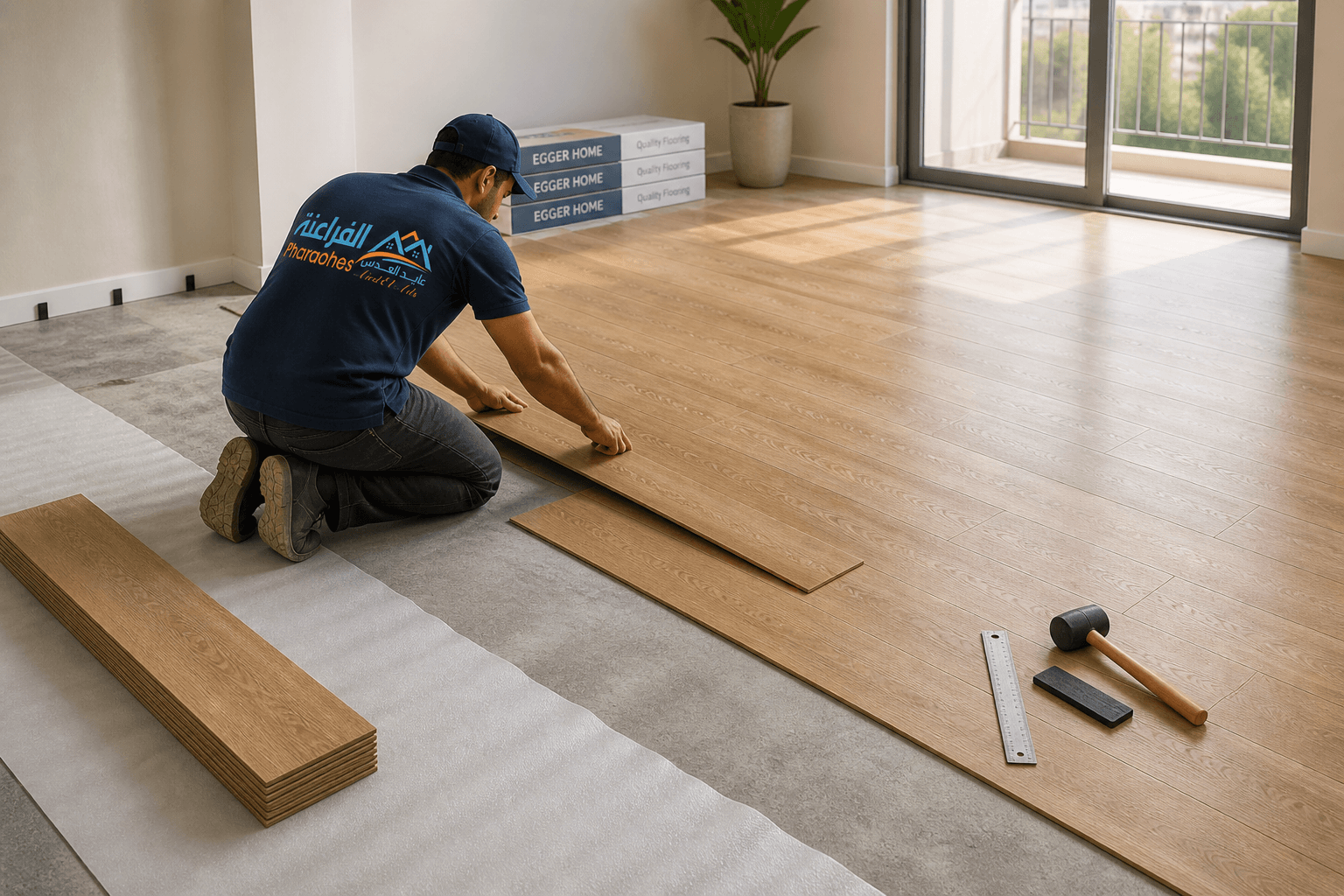

If you’ve been reading our previous blogs – from why Egyptian HDF (ABC) outperforms imported options to why Pharaohes is Egypt’s most trusted flooring distributor – you already know that choosing the right HDF flooring is only half the battle. The other half is installing it correctly.
In this comprehensive guide, we will walk you through every stage of HDF flooring installation – from the moment the delivery truck arrives at your home in Cairo, Alexandria, or any Egyptian city, to the final walk on your beautiful new floor. We’ll also explain how Pharaohes Company supports you before, during, and after installation with quality products, technical advice, and local expertise.
Before Installation – Receiving and Acclimating Your HDF Flooring
Inspecting the Delivery
When your HDF flooring arrives from Pharaohes, the first step is to inspect the packages:
- Check that the product matches your order (brand, color, thickness, AC rating).
- Look for any visible damage to the boxes (tears, water stains, crushed corners).
- Count the number of packages against the delivery note.
If you notice any issues, contact Pharaohes immediately via WhatsApp (01035683993) or email (info@pharaohes.org). We keep local stock of all our brands (Egger, Classen, AGT Wood, Floor Labs, ABC, Magic Floor) so replacements are fast – usually within 2-3 days. This is a key advantage of choosing a local distributor like Pharaohes over importing yourself or buying from an unknown online seller.
Why Acclimation Is Crucial in Egypt
HDF flooring expands and contracts with changes in temperature and humidity. Egypt’s climate swings – from dry, cool winter nights to hot, dusty summer days – mean your flooring needs time to adjust to your home’s environment. Skipping acclimation is the number one cause of gapped, buckled, or noisy floors in Egyptian homes.
How to acclimate properly:
- Leave the sealed boxes inside the room where they will be installed for at least 48 hours (72 hours is better, 96 hours for coastal areas like Alexandria or the North Coast).
- Keep the room temperature between 18°C and 25°C.
- Maintain moderate humidity (avoid extremely dry AC or open windows during dust storms).
- Do not open the plastic wrapping until you are ready to install – the wrapping protects the boards from sudden moisture changes.
Pro tip from Pharaohes: During Cairo’s humid winter (December–February) or dry summer (June–August), acclimation becomes even more critical. If you’re unsure, call us – we’ll advise based on current weather. We have seen many DIY installations fail simply because the homeowner installed the floor immediately after delivery. Don’t be that person.
Preparing the Subfloor – The Foundation of a Long-Lasting Floor
A perfect HDF floor starts with a flat, clean, dry subfloor. Most Egyptian homes have concrete (cement) subfloors. Here’s how to prepare them.
Checking for Flatness
Use a long spirit level (2 meters) or a straightedge. Place it on different areas of the floor. Gaps under the level should not exceed 3 mm over 2 meters. If the floor is out of level, your HDF planks will rock, the locking system will stress, and you will hear clicks when walking.
What if the floor is uneven?
- Small dips (<3 mm): Self-leveling compound can fix them. You can buy this at any building materials store in Egypt. Follow the mixing instructions carefully.
- Larger dips or slopes: You may need a professional screed. Pharaohes can recommend trusted contractors in Cairo, Alexandria, and other governorates. Do not try to fix major unevenness with thick underlayment – that is a temporary solution that will fail.
Ensuring the Subfloor Is Bone Dry
Moisture is the enemy of HDF. Even a small amount of rising damp from the concrete will cause edges to swell and locking systems to fail. In Egypt, older buildings (especially in Zamalek, Maadi, and downtown Alexandria) often have no damp-proof membrane under the concrete slab, making this step essential.
Simple moisture test: Tape a 50×50 cm plastic sheet to the floor. Leave it for 24 hours. If you see condensation underneath, the subfloor is too wet. Wait a few days and test again. If the problem persists, you may need a professional damp-proofing treatment.
Pharaohes advice: In old Egyptian buildings, always use a vapor barrier (polyethylene sheet of at least 0.2 mm thickness) over the concrete before laying any underlayment. Overlap the sheets by 20 cm and tape the seams. This adds almost nothing to your cost but prevents 90% of moisture-related problems.
Cleaning Thoroughly
Sweep and vacuum every grain of dust, sand, or debris. Even a tiny pebble will create a click or a bump under your new floor. Pay special attention to corners and edges. Use a damp cloth to wipe the floor after vacuuming – then let it dry completely before moving to the next step.
Underlayment – Why You Should Never Skip It
Underlayment is a thin foam or fiber layer placed between the subfloor and the HDF planks. It provides:
- Sound insulation (reduces echo and footstep noise – crucial for apartments).
- Moisture protection (especially if it has a built-in vapor barrier).
- Slight unevenness compensation (up to 1-2 mm).
- Improved walking comfort (softens the feel underfoot).
What underlayment does Pharaohes recommend?
- For standard residential use: 2 mm closed-cell foam underlayment. This is the most common and cost-effective choice.
- For extra moisture protection (ground floors or coastal areas): Underlayment with an integrated vapor barrier. This is a must for villas in the North Coast, Ain Sokhna, or any ground-floor apartment in Cairo.
- For added soundproofing (apartments): 3 mm recycled fiber underlayment. This exceeds the acoustic requirements of most Egyptian building codes.
We can supply underlayment matching all our HDF brands. Ask our team when you place your order. Never use carpet padding or construction felt – those are not designed for HDF and will cause problems.
Tools You Will Need
Before you start, gather these tools. Having everything ready will save you hours of running around mid-project.
| Tool | Purpose |
|---|---|
| Tape measure | Measure room dimensions and cutting lengths |
| Pencil | Mark cutting lines |
| Utility knife | Cut underlayment and open boxes |
| Pull bar | Tighten the last row of planks |
| Tapping block | Protect edges while tapping planks together |
| Rubber mallet | Tap the tapping block (never hit the plank directly) |
| Circular saw or jigsaw | Cut planks to size (use fine-tooth blade, cut from the back) |
| Spacers (wedges) | Maintain 8-12 mm expansion gap around walls |
| Safety glasses and dust mask | Protect eyes and lungs during cutting |
| Knee pads (optional but highly recommended) | Save your knees during long installation sessions |
Pharaohes tip: We can lend or recommend where to buy these tools in Cairo. Just ask. Some tools (like the tapping block and pull bar) often come in a laminate installation kit available at any hardware store for around 200-300 EGP. It’s a good investment.
Installation – Step by Step
Plan Your Layout
Decide which direction the planks will run. Usually, they should run parallel to the longest wall or toward the main light source (windows). This makes the floor look longer and hides minor imperfections.
- Measure the width of the room. Divide by the plank width (e.g., 187 mm for ABC brand). If the last row will be narrower than 5 cm, you should cut the first row narrower as well to balance. For example, if your room is 4 meters wide and planks are 187 mm, you’ll have about 21.4 planks across. The last row would be only 0.4 of a plank (about 7.5 cm) – too narrow. So cut the first row to 10 cm, then the last row will also be around 10 cm.
Prepare the Room
- Remove baseboards (skirting boards) carefully. Use a utility knife to cut the caulk line first, then a pry bar. You will reinstall them after the floor is done.
- Vacuum the subfloor one last time – don’t skip this even if you think it’s clean.
- Roll out the underlayment. Overlap seams by 5-10 cm and tape them with underlayment tape. Do not use regular duct tape – it dries out and fails.
- Place spacers against all walls – 8 to 12 mm gap is essential for expansion. In very large rooms (over 12 meters in any direction), leave 15 mm.
Start the First Row
- Place the first plank with the tongue side facing the wall (or groove side – follow your brand’s instructions. For most Pharaohes brands including ABC, the tongue faces the wall).
- Insert spacers between the plank and the wall.
- Connect the second plank to the first by angling it down and clicking it into place. Use the tapping block to gently tap the joint closed. You should hear a distinct click.
- Continue until the first row is complete. Cut the last plank to length (remember to leave the expansion gap). To cut, measure the remaining distance including the gap, mark the plank, and cut with a jigsaw or circular saw from the decorated side to avoid chipping.
Subsequent Rows
- Start the second row with the leftover cut piece from the previous row (if it is at least 30 cm long). This creates a staggered pattern (brick-like) which increases strength. If the leftover piece is shorter than 30 cm, cut a new plank in half to start the row.
- Connect the short end to the previous plank in the same row, then angle the whole row into the previous row’s long side.
- Tap gently until you hear the click. Work from left to right or right to left – keep consistent.
- Use the pull bar for the last row – hook it on the plank edge and tap with the mallet.
Common mistake: Forcing the click. If the planks don’t click easily, check for debris in the locking mechanism. Never hit the plank edge directly – always use the tapping block or pull bar.
Cutting Around Obstacles
Door frames, pipes, and pillars require special cuts:
- Door frames: Slide a scrap piece of HDF under the frame, mark the height, and cut the frame with a handsaw (or use an undercut saw). The flooring can then slide underneath – this looks much cleaner than notched planks. This technique is called “undercutting” and is the professional way.
- Pipes: Drill a hole in the plank 20 mm wider than the pipe diameter. Cut the plank in half through the hole, then glue the two pieces around the pipe using wood glue. Cover the joint with a matching pipe collar.
- Pillars: Cut notches in the planks and leave the expansion gap. Cover with matching transition profiles or a square trim piece.
Last Row
The final row will likely need to be ripped (cut lengthwise). Measure the remaining space (including the expansion gap). Subtract that from the plank width. Mark and cut. Use the pull bar to lock the last row into place. This row is the hardest – be patient.
Finishing Touches
Remove Spacers and Install Baseboards
- Remove all wall spacers after waiting at least 2 hours – this allows the floor to settle slightly.
- Reinstall baseboards (skirting) – they should cover the expansion gap but not press tightly against the floor. Leave 1-2 mm of play. Use 1.5-inch finishing nails or a brad nailer.
- Use quarter-round or shoe molding if your baseboards are already installed and you don’t want to remove them. This is a common trick to save time.
Install Transition Profiles
Where HDF meets another flooring type (tiles, carpet, or another room’s HDF), use transition strips:
- T-molding: Between two floors of similar height (e.g., HDF to HDF or HDF to tile with same thickness).
- Reducer: Between HDF and a lower floor (e.g., HDF to vinyl or to a lower tile).
- End cap: At doorways or sliding doors where the floor ends.
Pharaohes carries matching transitions for all our HDF brands. Ask us when ordering – having transitions in the same color and brand makes the finish look professional.
Clean the Floor
- Vacuum or sweep immediately to remove dust and small debris.
- Damp-mop with a well-wrung microfiber mop (almost dry). Never soak the floor – water will seep into the joints.
- Use only pH-neutral cleaners recommended for laminate/HDF. Avoid vinegar, bleach, or abrasive powders. Pharaohes can recommend a suitable cleaner if you are unsure.
After Installation – Care and Maintenance
Your new HDF floor will last 20+ years if you treat it right:
- Do not wet mop. Water seeps into the joints and causes swelling. Use a spray mop that applies very little water, or a microfiber mop that you ring out thoroughly.
- Use felt pads under furniture legs. Replace them every year or two – they compress and lose effectiveness.
- Lift – don’t drag heavy furniture or appliances. Use furniture sliders or carry the items.
- Place doormats at entrances to trap sand and dust. In Egypt, sand is abrasive and will scratch the wear layer over time.
- Wipe spills immediately – even water. Don’t let liquids sit for more than a few minutes.
Seasonal tips for Egypt:
- In summer (high heat, low humidity): You may notice small gaps (1-2 mm) between planks. This is normal and will close in winter. Keep indoor humidity stable (use a humidifier if needed). Running an evaporative cooler can help.
- In winter (cooler, occasionally damp): Avoid leaving wet shoes or umbrellas on the floor. Use a shoe rack near the entrance.
Why Choose Pharaohes for Your HDF Flooring Project?
Throughout this guide, we’ve emphasized the importance of climate-adapted products, proper acclimation, and correct installation. But none of that matters if you start with low-quality HDF from a distributor who disappears after the sale.
Pharaohes Company (established 2001) is Egypt’s leading distributor of premium HDF and laminate flooring. We partner with world-class brands – Egger, Classen, AGT Wood, Floor Labs, ABC, and Magic Floor – and we test every product for Egyptian conditions.
What sets us apart:
- Local expertise: 20+ years serving Cairo, Alexandria, and all governorates. We understand the challenges of Egyptian homes – from rising damp to dust storms to temperature swings.
- Genuine local warranty: We handle claims, not a foreign office. If a product defect appears, you deal with us – not a call center in Germany or China.
- Technical support: We answer your calls before, during, and after installation. Our team includes flooring specialists who have installed thousands of square meters.
- Stock availability: Extra boards for repairs? We keep inventory of every brand and color we sell. This is rare in Egypt – most distributors don’t hold stock.
- Contractor network: Need a trusted installer? We can recommend vetted professionals who know how to handle each of our brands.
Our showroom and contact info:
📍 10 Triumph Square, Heliopolis, Cairo – come see samples in person. We are open Saturday to Thursday, 10 AM to 6 PM.
📱 WhatsApp / Phone: 01035683993 | 01115555276 – we reply within 2 hours during business days.
🌐 Website: pharaohes.org – browse our gallery and download specification PDFs.
📧 Email: info@pharaohes.org – send your room dimensions and we will recommend the right quantity.
We invite you to read our related blog posts:
- Why Egyptian HDF Flooring Gives You More Value Than Other Options
- Why HDF Flooring Contractors in Cairo Prefer Dry Weather
- Why Pharaohes Company Is the Best Choice for Distributing HDF Flooring
Final Checklist for Homeowners
Use this checklist before you start and after you finish. Print it out if needed.
| Step | Done? |
|---|---|
| Ordered from Pharaohes with correct quantity (+5-10% waste) | ☐ |
| Acclimated boxes for 48-72 hours (96 hours for coastal areas) | ☐ |
| Prepared flat, dry, clean subfloor (checked with level and plastic sheet) | ☐ |
| Laid vapor barrier (if needed) and underlayment | ☐ |
| Maintained 8-12 mm expansion gap (15 mm for large rooms) | ☐ |
| Installed planks with staggered joints (minimum 30 cm offset) | ☐ |
| Used tapping block and pull bar – never hammered directly | ☐ |
| Cut around door frames (undercut, not notched) | ☐ |
| Removed spacers, installed baseboards with 1-2 mm play | ☐ |
| Cleaned with dry or slightly damp mop | ☐ |
Conclusion
Installing HDF flooring in your Egyptian home is a rewarding project – but it requires attention to detail, the right tools, and products designed for our climate. By following this guide and choosing Pharaohes Company as your flooring partner, you ensure that your floor will stay beautiful, stable, and silent for decades.
Ready to start your project? Contact Pharaohes today for a free consultation, product samples, and a fixed-price quote.
Call or WhatsApp: 01035683993 | 01115555276
Visit our showroom: 10 Triumph Square, Heliopolis, Cairo
Explore our brands: pharaohes.org
Pharaohes – Building Trust Since 2001, One Floor at a Time.